Design Prototypes: a GDS learning platform built on Rails
The goal was to teach what prototyping in code actually means. The outcome was a moderately successful learning product, with a new version on the way.
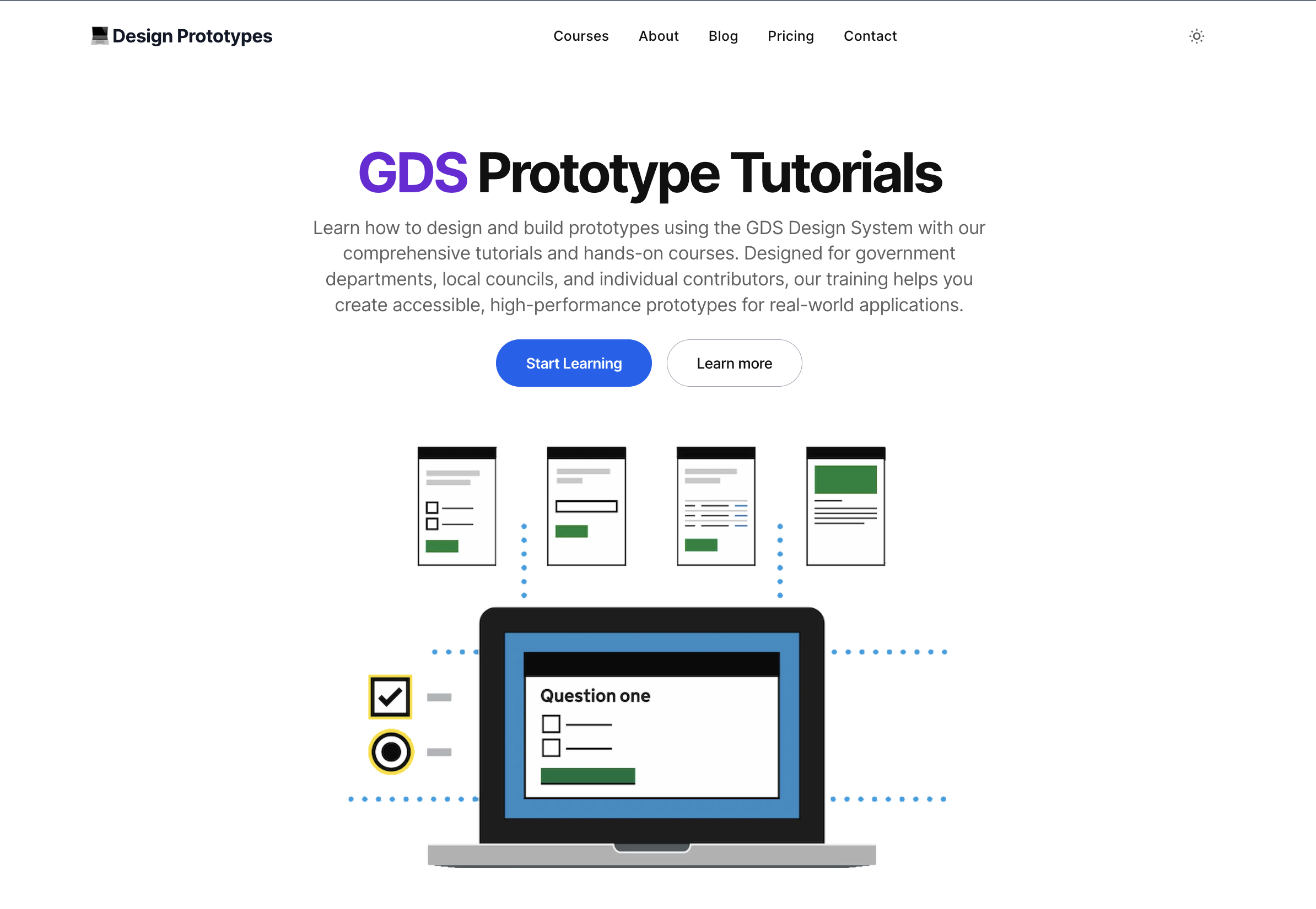
Problem Statement
Government departments, local councils, and individual contributors need to design and build prototypes using the GDS Design System. But learning materials were scattered. Figma alone doesn’t produce functional prototypes, and many designers never learn what happens between a mock and a working service. The gap between design tools and usable prototypes was real.
The brief was for a learning platform: hands-on courses that would help service designers, interaction designers, and researchers create accessible, high-performance prototypes. Not theory. Practice. Real prototypes with the GOV.UK Frontend, real journeys, real data handling.
Your Role and Process
Built a Rails learning platform. Hands-on courses, certificates, a design histories blog that connects theory to real work. The philosophy is simple: highly functional, accessible, and performant prototypes make better services. The platform delivers that through a three-step learning journey and content grounded in real government design work.
The current version is under construction—second iteration, with a focus on expanding the video platform and adding more course content. Moderately successful so far, enough traction to justify the next phase.
Design Solutions
GDS prototyping curriculum
Design Prototypes teaches rapid prototyping with GDS standards. Four core offerings: rapid prototyping with GDS (working interfaces, not static mockups), efficiency in delivery (concept to usability testing with minimal iterations), data integration (APIs, real and synthetic data), and innovative design practices (design histories, iterative workflows, evidence-based decisions).
Three-step learning journey
The platform guides learners through: enroll in a course, build and test with real-world examples, then earn a certificate of completion. Content is tailored to service designers, interaction designers, and researchers at different experience levels. Courses include the free Introduction to GDS Prototyping for beginners, plus paid options for those ready to go deeper. Hands-on from the start: create real prototypes with the GDS Front End library, styled with GOV.UK CSS.
The blog as curriculum
The blog is not filler. It displays design histories and case studies from UK Government departments: the kind of work the courses prepare learners for. Posts cover macro interactions, progressive disclosure, postcode search, and design histories as a practice. This content grounds the courses in real outcomes. Learners see what the skills produce. They read the reasoning behind design decisions, not just the mechanics.
Why Figma isn’t enough
The platform’s FAQ addresses a common misconception: Figma is a great design tool, but it is not a prototyping system. Static screens and click-through flows don’t test how users handle real forms, real validation, real data. The courses teach the GDS kit to create highly functional, accessible, and performant prototypes. That’s a different skill set.
Technical choices
Built on Ruby on Rails: familiar territory for rapid product development, with conventions that support fast iteration. The same stack used for peponi.to.
Outcomes and Metrics
Live at design-prototypes.com. Serving government departments, local councils, and individual contributors.
Courses, certificates, design histories blog. Connects theory to real work. Learners understand the complete lifecycle: design, user testing, iteration, preparation for assessment.
Second iteration in progress. Expanded video platform and curriculum. Enough traction to justify the next phase.